
Local Media Empire Review: Is This AI Local Media Platform Worth Considering?
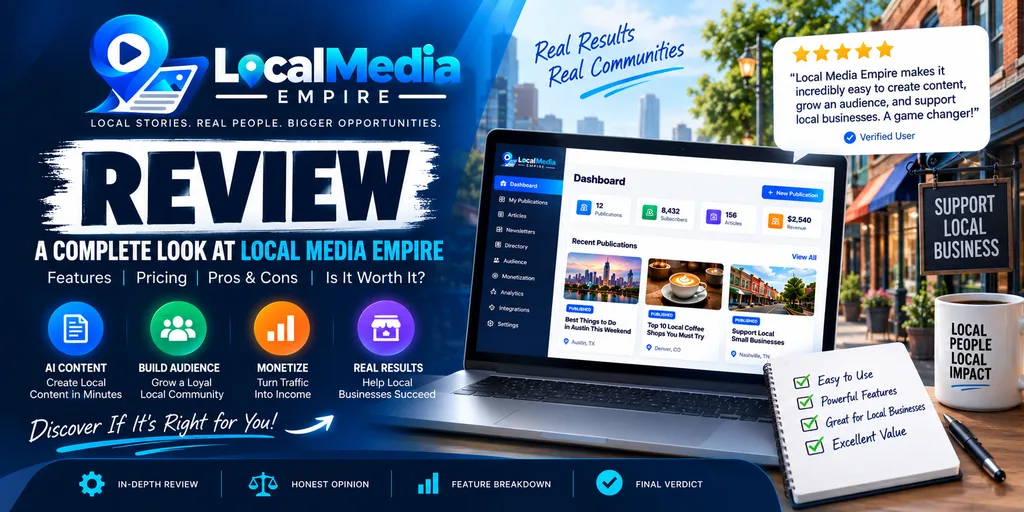
Build a local audience, publish useful content, and create a media asset you actually control.
Local Media Empire takes a different approach from the usual “make money online” software. Instead of focusing on a short-term traffic trick, it is built around something more durable: publishing useful local information and building an audience around it.
The platform helps users create locally focused articles, publish them to a branded media website, turn that content into newsletter issues, collect subscribers, and build a growing library of content from one place.
The bigger question is not whether the software can publish articles.
The real question is whether this business model makes sense for the person using it.
That is where this Local Media Empire review becomes useful.
Quick Local Media Empire Review
Here is the short version.
Local Media Empire is most interesting for someone who wants to build a local digital media property, rather than simply run another affiliate page or send occasional promotional emails.
The core offer combines:
- AI-assisted local article creation
- A professional media website
- Newsletter publishing
- Email subscriber tools
- Custom domains
- SEO and AEO-oriented publishing features
- Audience management
- Support for up to 10,000 subscribers
- Ways to promote your own offers, affiliate products, or generate leads
The front-end version is currently listed at $37 as a one-time purchase.
Optional upgrades expand the system into multiple publications, local advertising, business directories, and client management.
That means Local Media Empire does not fit into only one business model.
It can be used as:
a local newsletter business, a local publishing website, a lead-generation property, an advertising platform, a business directory, or a client service.
That flexibility is one of its strongest points.
At the same time, it can become a distraction if someone buys every upgrade without first deciding what kind of business they actually want to build.
What Makes Local Media Empire Different?
There are plenty of newsletter tools.
There are plenty of AI writing tools.
There are also countless website builders.
Local Media Empire becomes more interesting because it connects all three.
Instead of using a workflow like this:
AI writer → copy article → WordPress → email tool → newsletter → subscriber plugin → analytics → separate advertising software
the platform is designed to handle much more of the publishing process inside one ecosystem.
That makes sense for a solo operator.
Someone running a local publication probably does not want to spend Monday fixing plugins, Tuesday connecting forms, Wednesday formatting newsletters, and Thursday trying to figure out why subscriber data is not syncing correctly.
The goal is to publish.
Local Media Empire is built around that reality.
Its feature set includes a professional media website, AI-created local articles, newsletter creation, email and web publishing, signup pages, audience management, custom domains, scheduling, schema, sitemaps, and integrations with existing autoresponder or SMTP setups.
In simple terms, it is trying to work less like a single tool and more like the operating system behind a small local publication.
The Business Model Matters More Than the Software
Here’s what most people don’t know: software usually is not the hardest part of building a local media business.
Getting people to care is.
A publisher could have the fastest platform in the world, but if the content feels generic, inaccurate, or disconnected from the community, readers will not keep coming back.
That is why Local Media Empire makes the most sense when viewed as a leverage tool, not a push-button business.
AI can help with research.
It can help create drafts.
It can reduce the time needed to prepare a newsletter.
It can make publishing more consistent.
But it still needs direction.
Imagine two people using exactly the same platform.
One publishes broad articles such as:
“10 Things to Do in Dallas”
The other creates a publication focused on one growing suburban area and regularly covers:
- restaurant openings
- local events
- construction projects
- school activities
- neighborhood developments
- business openings
- weekend guides
The second publication has a much better chance of becoming part of the local routine.
The tool matters.
The market choice and editorial judgment matter even more.
Is the AI Content Feature Actually Useful?
Potentially, yes.
Local publishing can become demanding because fresh content matters.
A weekly publication needs ideas, research, writing, editing, formatting, and distribution.
That workload can grow quickly.
Local Media Empire includes AI local content research and AI article creation, with the broader feature list also describing unlimited AI articles.
That can remove a large part of the blank-page problem.
However, AI output should not automatically be treated as finished local reporting.
Local content often includes details that deserve verification:
- dates
- addresses
- opening hours
- event information
- business names
- prices
- phone numbers
- public announcements
The biggest mistake people make is assuming that “AI-powered” means “human review is no longer required.”
It does not.
The stronger approach is:
AI for speed + human verification + local judgment.
That combination can save time without turning the publication into a stream of generic machine-written content.
Does Local Media Empire Solve the Audience Problem?
Partly.
The platform gives users the tools to capture and manage subscribers.
That includes signup pages, confirmation pages, email and web publishing, audience management, and support for up to 10,000 subscribers on the core offer.
But software cannot create demand by itself.
Readers still need a reason to discover the publication in the first place.
Traffic could come from:
- search engines
- social media
- community groups
- partnerships
- local businesses
- events
- referrals
- offline promotion
Once someone becomes a subscriber, the economics improve.
There is no need to win that person’s attention from scratch every single week.
A direct communication channel already exists.
That is why an owned email audience can become valuable over time.
It creates a relationship instead of relying only on one-time visits.
The $37 Version: Is It Enough to Start?
For many users, probably yes.
The front-end version includes the main pieces needed to begin building a local publication:
| Included Area | Core Capability |
|---|---|
| Content | AI-powered local articles |
| Website | Branded local media publication |
| Newsletter | Newsletter builder |
| Publishing | Email + web distribution |
| Search | SEO/AEO-oriented content |
| Subscriber Growth | Signup and confirmation pages |
| Audience | Central subscriber management |
| Capacity | Up to 10,000 subscribers |
| Monetization | Own offers, affiliate promotions, lead generation |
Those capabilities are included in the core platform.
That makes the $37 version more than a stripped-down entry product.
It can be used to validate the idea before adding more tools.
A sensible path would be:
Start with one publication.
Choose one market.
Create useful content.
See whether people subscribe.
Then decide whether additional tools are actually needed.
That approach keeps the business simple.
Local Media Empire Pro: Who Needs It?
Local Media Empire Pro costs $67 one time.
It expands the platform with:
- up to 10 local publications
- unlimited subscribers
- live comments
- RSS feed pulling
- a public directory feature
- co-registration widgets
This upgrade makes more sense once the goal becomes expansion.
If someone is launching a first publication, managing 10 markets on day one may create more distraction than opportunity.
One useful publication is better than 10 half-finished ones.
The upgrade becomes much more interesting for users who already understand the process and want to repeat it across multiple cities, towns, or local markets.
Unlimited subscriber capacity may also matter later for someone who expects to grow beyond the 10,000-subscriber allowance on the core version.
Local Advertiser: Where Monetization Gets More Serious
Local Advertiser costs $97 one time.
This upgrade changes the business model in an important way.
Instead of relying only on personal products, affiliate offers, or lead generation, publication owners can sell advertising directly to local businesses.
The upgrade includes:
- three banner ad sizes
- multiple website placements
- newsletter advertising
- campaign scheduling
- automatic ad rotation
- built-in billing
- automatic invoices
- advertiser accounts
- self-service ad management
- an advertising sales page
This is one of the more commercially interesting parts of the product.
Imagine a local publication with 5,000 engaged subscribers in one city.
A nearby restaurant, dentist, realtor, gym, home-service company, or event organizer may care much more about those 5,000 people than 50,000 unrelated followers spread across the country.
That is the advantage of local attention.
It is concentrated.
Local Advertiser provides the infrastructure for turning that attention into a real advertising product.
Of course, businesses will not automatically buy ads simply because the feature exists.
A publication still needs an audience worth reaching.
Local Directory: Bigger Opportunity, Bigger Responsibility
The Local Directory upgrade costs $197 one time.
This is not just a page with business names.
The system includes tools for:
- finding local businesses
- creating detailed listings
- categories and subcategories
- dedicated business URLs
- schema
- sitemap inclusion
- business claiming
- listing management
- local outreach
- hot spots
- local events
The logic behind this is strong.
A newsletter is something people may open once or twice a week.
A directory gives them a reason to visit whenever they are looking for a restaurant, service provider, professional, event, or local destination.
That adds another layer of usefulness.
It can also expand the searchable footprint of the publication because eligible businesses can have dedicated pages.
There is a tradeoff, though.
A directory is only valuable if the information is useful.
Hundreds of incomplete or outdated listings are not much of an asset.
So while the directory can make the publication larger and more useful, it may also create more information to maintain.
What About the Client Version?
The Client Version opens a completely different business model.
Instead of creating publications only for personal use, users can build and manage them for clients.
It supports:
- adding clients
- client login access
- done-for-you management
- client publications
- client articles
- multiple client accounts
The product information also describes a $297 newsletter setup package and a $497 newsletter + directory package as possible client-service offers.
That does not mean every client will pay those exact prices.
It does, however, show how the platform can be positioned as a service rather than simply as publishing software.
For agencies, consultants, or local marketers, that may be more appealing than operating their own publication.
Strong Points of the Local Media Empire Model
Several aspects stand out.
You Build Something You Control
The business does not have to live entirely inside a Facebook page, social account, or third-party platform.
The model centers on:
- a website
- a content library
- an email audience
- a recognizable brand
That creates a stronger long-term foundation.
Multiple Monetization Paths
The platform is not tied to one revenue source.
Depending on the version and strategy, a publication could support:
- affiliate offers
- personal services
- lead generation
- advertising
- directory relationships
- client services
That flexibility is useful because different local markets may respond to different models.
AI Reduces the Publishing Burden
Producing local content consistently can become exhausting.
AI assistance with research, writing, newsletter creation, and publishing can make the workload more realistic for one person.
Local Audiences Can Be Commercially Valuable
A smaller local audience can be more attractive to certain businesses than a much larger general audience.
Relevance often matters more than raw follower count.
Where Extra Care Is Needed
No useful review should focus only on advantages.
There are several points worth considering.
AI Does Not Replace Local Knowledge
A generic publication created entirely through automation may struggle to feel genuinely local.
Editorial judgment still matters.
Traffic Still Has to Come From Somewhere
Local Media Empire provides publishing and subscriber tools.
It does not automatically deliver thousands of readers.
Audience building is still part of the business.
More Features Can Mean More Work
Directories, advertisers, client accounts, and multiple publications create new opportunities.
They also create new responsibilities.
Adding everything at once can turn a simple media project into something unnecessarily complicated.
Revenue Is Not Automatic
The platform creates ways to monetize.
That is different from guaranteed income.
A successful publication still needs readers, subscribers, relevant offers, advertisers, leads, or paying clients.
Who Should Consider Local Media Empire?
The platform makes the most sense for people who can clearly answer this question:
What local audience is this publication going to serve?
Potential users include:
Local marketers who understand a particular community.
Realtors and local professionals who want to build authority instead of relying only on advertising.
Affiliate marketers who want to build an audience asset rather than depend completely on search traffic.
Content creators interested in moving followers onto an owned email list.
Agencies and consultants that could offer local publishing services.
Entrepreneurs and side-hustlers willing to build a focused local brand over time.
It is probably less suitable for someone looking for instant traffic or an automatic income system.
Publishing tends to compound.
It rarely becomes valuable overnight.
Is Local Media Empire Worth It?
The answer depends on the goal.
At $37 one time, the core platform includes a broad set of publishing tools: AI-assisted local content, a media website, newsletter creation, subscriber management, email and web publishing, and several possible monetization paths.
That makes the front-end version an interesting low-cost way to test the local media model.
The upgrades become more relevant when there is a clear reason to use them.
Need multiple markets?
Pro may make sense.
Want to sell local advertising?
Local Advertiser becomes relevant.
Want a serious local directory?
The directory upgrade becomes more important.
Planning to build publications for clients?
The Client Version is designed around that use case.
The smartest approach is to build the business backward from the result you want.
That is usually better than building the business around every feature that happens to be available.
Final Verdict
Local Media Empire has an interesting premise because it combines modern AI with a very old idea:
serve a specific community with useful information.
The platform is designed to make researching, creating, publishing, and distributing that information easier without requiring a traditional media team.
But the biggest opportunity is not the AI writer.
It is the audience.
A strong local publication can become more valuable as articles, subscribers, and business relationships accumulate over time.
That is where the platform has the most potential.
Local Media Empire provides the infrastructure.
The real results will still depend on the market selected, the usefulness of the content, the trust built with readers, and the consistency of the publication.
For someone who understands that distinction, the platform offers an interesting way to build a local media property without having to assemble the entire technology stack from scratch.